PHILLIS WHEATLEY: POET & PATRIOT
PROGRAM TOOLKIT FOR AMERICAN SPACES
An American Hero
This toolkit is designed for programming at American Spaces to highlight Phillis Wheatley’s contributions to literature, history, and early American identity.
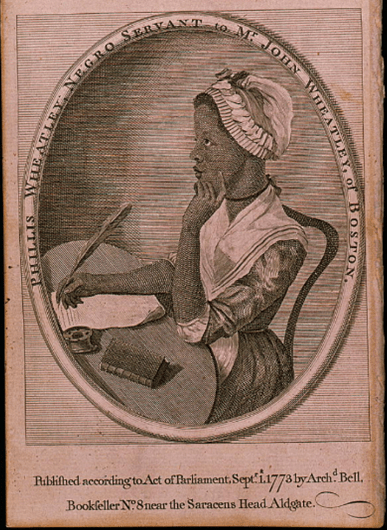
Image credit: Library of Congress
An engraving of Phillis Wheatley seated at a desk with a quill and paper, looking upward for inspiration.
RESOURCES
Biographical overviews
- National Park Service – Concise biography covering her enslavement, education, poetic career, emancipation, marriage, poverty, and death, with context on her significance as one of the first African American writers in the U.S. to publish a book of poems.
- Library of Congress – Focuses on the 1773 publication of Poems on Various Subjects, Religious and Moral and links to related LOC exhibitions and collections.
Library of Congress collections and exhibitions
- Phillis Wheatley – a six-minute downloadable video about the poet.
- American Treasures of the Library of Congress – A Voice of Her Own – Exhibition entry describing Wheatley as an “extraordinary poetical genius,” with links to digitized images from Poems on Various Subjects, Religious and Moral in the Rare Book and Special Collections Division.
National Archives and Founders Online (Washington correspondence)
- Enclosure: Poem by Phillis Wheatley, 26 October 1775 | Founders Online, National Archives – Annotated document showing the poem as it appeared in the Pennsylvania Magazine and summarizing her life (kidnapping in Africa, arrival in Boston, education, publication of her 1773 volume, and her meeting with George Washington).
- George Washington to Phillis Wheatley, 28 February 1776 | Founders Online, National Archives – George Washington’s letter praising her “great poetical Talents,” with editorial notes on how her poem went into print.
INTRODUCTION
Phillis Wheatley (c. 1753–1784) challenged the world’s perception of intellect in the 18th century. Born in the Senegambia, a region of West Africa, Phillis was enslaved and brought to Boston as a child. She mastered the English language and published a groundbreaking volume of poetry that garnered acclaim in America and England. In 1773, she traveled to London to publish her book, Poems on Various Subjects, Religious and Moral, becoming an international celebrity. She was manumitted (freed) shortly after her book’s publication but died in poverty at a young age.
Video
- Phillis Wheatley | The White House (2 minutes) – Created with American artificial intelligence tools, this video brings Wheatley’s portrait to life.
DISCUSSION QUESTIONS
- Why did Phillis Wheatley have to undergo an examination by 18 men to get her book published? What does this tell us about the society she lived in?
- How did Wheatley’s West African heritage influence her writing style?
- Wheatley wrote about freedom for America while being enslaved herself. How do you think she reconciled these two realities in her writing?
OverDrive (Libby) Resources
Consider organizing discussions, English conversation clubs, scavenger hunts, and displays about the following books and magazines. These programs and displays can also be an opportunity to promote individual eLibraryUSA accounts. Regularly highlighting one book or magazine on your social media platforms can generate online discussion and spark interest in eLibraryUSA.
The Trials of Phillis Wheatley | OverDrive
This brief biography of Wheatley explains how major Americans at the time – such as George Washington, Thomas Jefferson, and Benjamin Franklin – viewed her groundbreaking work.
DISCLAIMER
The views expressed in these links and resources do not necessarily reflect those of the U.S. government.
* Post may need to procure these films. Not all films are appropriate for all audiences. Coordinators should preview films before showing them. American Spaces have the right to screen Kanopy films (available through eLibraryUSA) at their American Space if the film has public performance rights. Other films must be covered by the MPLC license.
Here is more information on showing films at American Spaces.
Updated June 2026