HARPER LEE
PROGRAM TOOLKIT FOR AMERICAN SPACES
An American Hero
This toolkit is designed for programming at American Spaces to explore Harper Lee’s life and literary contributions, and to examine the lasting significance of To Kill a Mockingbird in American literature and cultural history.
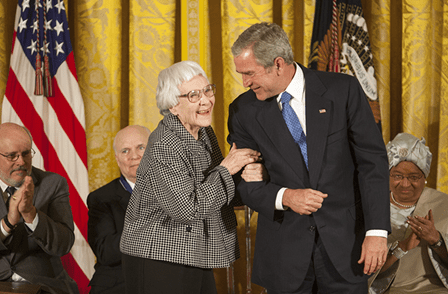
Photo credit: White House
President George W. Bush awards the Presidential Medal of Freedom to author Harper Lee in 2007.
“To Kill a Mockingbird has influenced the character of our country for the better. It’s been a gift to the entire world. As a model of good writing and humane sensibility, this book will be read and studied forever.”
President George W. Bush
RESOURCES
Videos and Digital Media
To Kill a Mockingbird (129 minutes)* – this classic 1962 film adaptation of Harper Lee’s Pulitzer-winning novel won three Academy Awards and remains the definitive cinematic version of the story. In 1995 the Library of Congress selected the film for inclusion in the National Film Registry.
Hey, Boo: Harper Lee & To Kill a Mockingbird (78 minutes)* – feature documentary chronicling the impact of Lee’s novel and the cultural phenomenon around it, featuring interviews and archival material.
Harper Lee: American Masters (84 minutes)* – PBS documentary exploring Lee’s life, her rise to fame, the influence of To Kill a Mockingbird, and social context around the work.
KEY DEFINITIONS
civil rights – Basic rights and freedoms guaranteed to all citizens, including equal treatment under the law.
Jim Crow – A system of laws and practices in the United States that enforced racial segregation, especially in the South.
jury – A group of citizens who listen to a trial and decide the outcome.
legacy – The lasting influence or impact someone leaves behind.
prejudice – An unfair or negative opinion about someone without knowing the facts.
Pulitzer Prize – A major American award given for excellence in writing and journalism.
reclusive – Avoiding public attention and preferring to live privately.
reputation – The way a person is viewed or judged by others.
trial – A formal legal process in a court to decide if someone is guilty or not guilty.
verdict – The final decision made by a jury in a trial.
INTRODUCTION
Harper Lee (April 28, 1926 – February 19, 2016) was an American author whose novel To Kill a Mockingbird became one of the most widely read works in American literature. Published in 1960, the novel won the Pulitzer Prize and has been translated into many languages.
Set in the American South during the Great Depression, the story explores themes of justice, prejudice, and moral courage through the eyes of a child.
Harper Lee’s work reflects the power of American literature to examine national history and values while encouraging thoughtful debate at home and abroad.
BACKGROUND INFORMATION
Harper Lee was best known for her novel To Kill a Mockingbird. The book is set in the 1930s American South and told from the point of view of a child whose father, a lawyer, defends a Black man wrongly accused of a crime.
The novel explores themes such as justice, fairness under the law, prejudice, moral courage, and empathy. After publication, it became widely read in the United States and around the world. It also inspired a celebrated 1962 film adaptation.
To Kill a Mockingbird is frequently taught in schools and discussed in many civic and literary forums because it encourages reflection on legal institutions, personal responsibility, and how individuals engage with difficult social issues. The novel’s continued relevance shows how literature can spark dialogue about society, law, and civic participation.
MAIN CONTENT
PROGRAM FORMATS
Programs celebrating the life and work of Harper Lee can feature many different topics or formats. Some ideas include:
Civic Participation
- Host programs that showcase the excellence of the American legal system, including mock trials.
Debate and Freedom of Expression
- Participants can practice structured dialogue about topics such as the law, censorship, privacy rights, and free speech.
Culture and History
- The novel is set in a historically significant time and place in America. Participants may deepen their understanding of American history by reading or watching To Kill a Mockingbird.
LESSON PLANS
To Kill a Mockingbird: A Historical Perspective | Classroom Materials at the Library of Congress | Library of Congress
“To Kill a Mockingbird”: An Introduction to 1930s America | U.S. Census Bureau
To Kill a Mockingbird | National Endowment for the Arts
DISCUSSION QUESTIONS
- Why do you think To Kill a Mockingbird became one of the most widely read American novels in the world?
- What makes American literature influential beyond the United States?
- How can novels and films help a country share its history and values with global audiences?
- How does the American legal system, as shown in the story, reflect important ideas about justice?
- How does the 1962 film adaptation show the strength of the U.S. film industry in bringing literature to new audiences?
- Why do some American books continue to shape public discussion many decades after publication?
- Why do you think the White House selected Harper Lee as an American Hero?
OverDrive Resources
Consider organizing discussions, English conversation clubs, scavenger hunts, and displays about the following books and magazines. These programs and displays can also be an opportunity to promote individual eLibraryUSA accounts. Regularly highlighting one book or magazine on your social media platforms can generate online discussion and spark interest in eLibraryUSA.
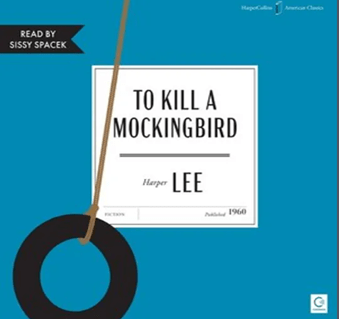
To Kill a Mockingbird – Set in 1930s Alabama, this novel follows a young girl whose father defends a man falsely accused of a crime, exposing deep prejudice in their community. Published in 1960, it became one of the most influential American novels of the 20th century and continues to shape discussions about justice and equality. American actress Sissy Spacek narrates this audiobook version. Also available as a graphic novel in Libby.
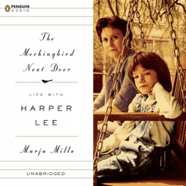
The Mockingbird Next Door – This memoir by Marja Mills recounts her friendship with her neighbors: Harper Lee and her sister, Alice Lee. The book offers a rare look at the famously private author and explores the lasting impact of To Kill a Mockingbird on her life and legacy. Available as an audiobook.
DISCLAIMER
The views expressed in these links and resources do not necessarily reflect those of the U.S. government.
* Post may need to procure these films. Not all films are appropriate for all audiences. Coordinators should preview films before showing them. American Spaces have the right to screen Kanopy films (available through eLibraryUSA) at their American Space if the film has public performance rights. Other films must be covered by the MPLC license.
Here is more information on showing films at American Spaces.
Updated June 2026